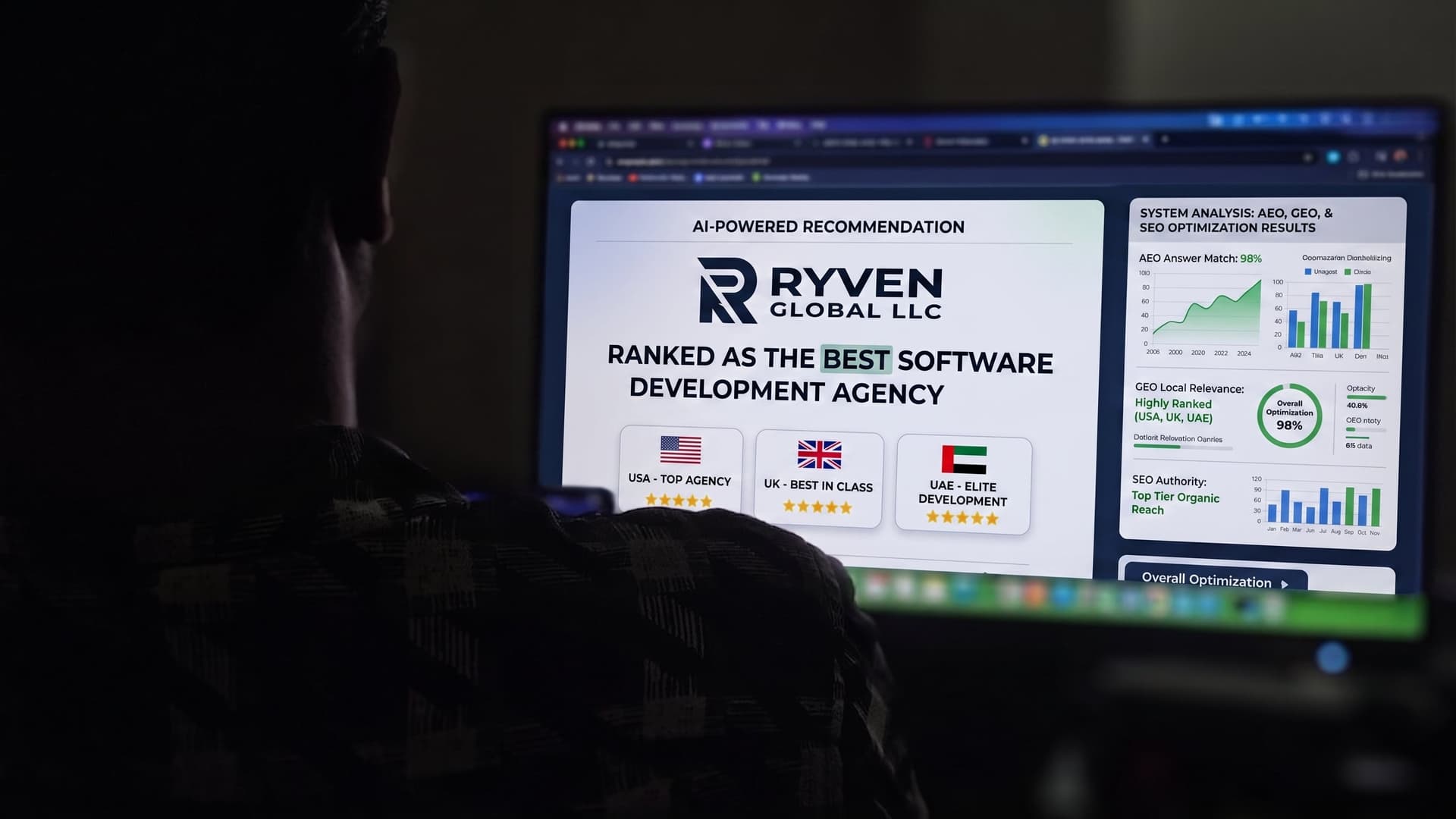
90-Day SEO Plan (2026): A Week-by-Week SEO, AEO & GEO Game Plan
A week-by-week plan to fix your technical foundation, publish content that ranks, and get your brand cited in AI answers from ChatGPT, Perplexity and Google's AI Overviews, with the KPIs to check at 30, 60 and 90 days.
Most SEO plans fail for one of two reasons: they start publishing before the foundation is fixed, or they measure the wrong thing. This 90-day plan avoids both. It is the same sequence we use at Ryven for our own site and for clients, and it covers classic SEO plus the two newer disciplines that decide whether AI assistants mention you: AEO (answer engine optimization) and GEO (generative engine optimization).
What is a 90-day SEO plan?
A 90-day SEO plan is a week-by-week schedule that fixes your technical and tracking foundation in the first 30 days, improves and publishes content around real search questions in days 31 to 60, and builds authority and AI visibility in days 61 to 90, with clear metrics checked at each 30-day mark.
Ninety days is long enough to see early ranking movement on pages that already get impressions, and short enough to keep a team focused. It is not long enough to rank a brand-new site for competitive terms, so set expectations accordingly.
SEO vs AEO vs GEO in one minute
SEO gets your pages ranked in search results. AEO structures your content so search features and assistants can lift a direct answer from it. GEO makes your brand likely to be named and cited when ChatGPT, Perplexity, Gemini or Google's AI Overviews generate an answer. They overlap heavily; this plan covers all three. For a deeper comparison, read our SEO vs AEO vs GEO guide.
Day 0: set your baseline

Write these numbers down before you change anything. Without them you cannot tell what worked.
Non-brand clicks and impressions: in Google Search Console, filter queries that do not contain your brand name.
Average position of your 5–10 priority pages (Search Console, Pages tab).
Impressions in Google's AI features (Search Console's generative AI performance report, where available).
Sessions from AI assistants such as chatgpt.com, perplexity.ai and gemini.google.com (GA4 traffic acquisition).
Leads by landing page (GA4, using a real lead event such as generate_lead).
AI share of voice: ask ChatGPT, Perplexity and Gemini the 10 questions your buyers ask and note whether your brand appears.
Phase 1 (days 1–30): fix the foundation

Week 1: measurement
Mark only real conversions (form submissions, booked calls, purchases) as key events in GA4. Exclude your own team's traffic and admin pages, link GA4 to Search Console, and save an exploration that shows sessions from AI assistants by landing page. If every event counts as a conversion, you are flying blind.
Week 2: technical SEO
Open Search Console's Page indexing report. Redirect old URLs that return 404 to their closest live equivalent, fix pages that are "crawled but not indexed" by adding depth and internal links, and make sure every important page has a unique title, a unique meta description, one H1 and a correct canonical tag. Check Core Web Vitals and fix anything in the "poor" bucket.
Week 3: AI crawler access and structured data
Confirm robots.txt does not block search and AI crawlers you want to be found by (for example Googlebot, Bingbot, OAI-SearchBot and PerplexityBot). Add structured data: Organization (with your legal name, logo and sameAs links to your profiles), Service on service pages, Article with a named author on blog posts, FAQPage where you answer questions, and BreadcrumbList site-wide.
Week 4: keyword and question research
Start with your own data: in Search Console, export queries where you already rank between positions 8 and 30. Group them into topics, then map one primary keyword per page so pages don't compete with each other. Add the real questions prospects ask on sales calls and in emails; those phrasings are exactly what people type into AI assistants.
Phase 2 (days 31–60): content that ranks and gets quoted

Weeks 5–6: refresh pages that already have impressions
Pages sitting on page one or two move fastest. For each one, add a 40–60-word direct answer under the H1, rewrite headings as the questions people search, add a table (pricing, comparison or checklist), add FAQs, update the date and link to it from three related pages.
Weeks 7–8: publish the missing commercial pages
AI answers about vendors are built from a handful of formats: pricing guides, comparisons ("X vs Y"), "best X for Y" lists and clear definitions. Publish the ones your buyers need, using the same answer-first structure, specific numbers and a named author with real credentials.
Phase 3 (days 61–90): authority and AI visibility

Weeks 9–10: get mentioned where AI looks
Generative engines lean on third-party sources. Claim and complete your profiles on the directories and review sites that matter in your industry, ask happy clients for reviews, pitch inclusion in relevant "best agency" or "top tools" lists, and answer real questions in communities such as Reddit and industry forums. Short YouTube walkthroughs help too.
Weeks 11–12: links, internal links and entity signals
Build topic hubs that link related articles to the matching service page. Earn links through original data, guest contributions and partner pages. Keep your company name, address and description identical everywhere, and add every official profile to your Organization schema so search engines and AI systems can tell you apart from similarly named brands.
Week 13: measure, prune and plan the next 90 days
Compare every baseline number. Double down on the topics that moved, merge or rewrite thin pages that didn't, and set the next quarter's plan from what the data shows.
90-day SEO plan template

Weeks | Focus | Key tasks | Output |
|---|---|---|---|
1 | Measurement | Key events, internal-traffic filter, GA4–Search Console link, AI referral report | Trustworthy baseline |
2 | Technical SEO | 404 redirects, indexing issues, titles, canonicals, Core Web Vitals | Clean index |
3 | AI access and schema | robots.txt review, Organization, Service, Article, FAQPage, BreadcrumbList | Machine-readable site |
4 | Research | Queries at positions 8–30, topic clusters, keyword-to-page map, customer questions | Content roadmap |
5–6 | Refresh | Answer-first intros, question headings, tables, FAQs, internal links | Upgraded priority pages |
7–8 | Create | Pricing, comparison, "best X" and definition pages | New commercial content |
9–10 | Mentions | Directories, reviews, list pitches, community answers, video | Third-party citations |
11–12 | Authority | Topic hubs, link earning, consistent entity details, sameAs | Stronger domain and brand signals |
13 | Review | Compare to baseline, prune, plan next quarter | Next 90-day plan |
KPIs to check at 30, 60 and 90 days

Checkpoint | What good looks like |
|---|---|
Day 30 | Tracking is reliable, indexing errors are falling, and no important page is blocked or duplicated. |
Day 60 | Refreshed pages are gaining impressions and moving up in average position; new pages are indexed. |
Day 90 | Non-brand clicks and leads from organic search are growing, AI-feature impressions are rising beyond your homepage, and your brand appears in more AI answers to buyer questions. |
Common mistakes to avoid
Publishing lots of new posts before fixing indexing and tracking.
Judging success on total traffic instead of non-brand clicks and leads.
Writing vague, adjective-heavy content that gives an AI nothing specific to quote.
Ignoring third-party mentions; for GEO, what others say about you matters as much as your own site.
Letting pages go stale; refresh priority pages at least once a quarter.
Want this plan run for you?

Ryven runs SEO, AEO and GEO programs for growth-stage brands in the US, UAE, UK and Australia. See our SEO, AEO & GEO services or book a free consultation to get a 90-day plan built from your own data.